
Coca-Cola tests adhesive dots and cardboard handles as an alternative to shrink film for PET bottle multipacks in Germany and France.
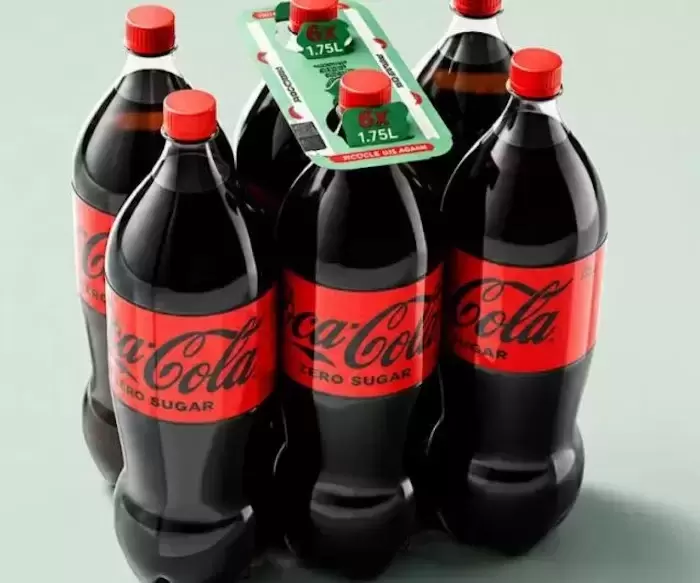
Coca-Cola tests adhesive dots as an alternative to shrink film
Coca-Cola and Coca-Cola Europacific Partners are testing a new secondary packaging format that eliminates conventional shrink film from PET bottle multipacks.
The limited retail trial in Germany and France uses strategically positioned adhesive dots to hold individual PET bottles together, combined with a rigid cardboard carrying handle that allows consumers to transport the multipack.
The approach is designed to reduce the amount of secondary plastic packaging while maintaining the stability required during distribution, retail handling and consumer use.
Adhesive connections replace plastic shrink film
Traditional PET multipacks often rely on shrink film to hold several bottles together during transport and retail display.
In the new format, individual bottles are connected using adhesive points positioned at specific locations around the pack.
The connections are designed to provide sufficient strength during logistics and handling while allowing consumers to separate the bottles after purchase.
Cardboard handle provides carrying function
A rigid cardboard component is fitted to the assembled bottles to create a carrying handle.
This allows the multipack to retain a familiar handling function without requiring a plastic outer film.
Once the bottles have been removed, the cardboard component can enter the appropriate paper and cardboard recycling stream, while the PET containers remain compatible with established bottle collection systems.
Consumer separation becomes part of the design
The new format changes the way consumers open and separate a multipack.
Bottles can be detached by gently twisting or carefully pulling them apart, rather than tearing through a continuous plastic film.
Because this interaction is different from conventional shrink-wrapped packaging, Coca-Cola is using graphic instructions and point-of-sale communication to explain the separation process.
Trial evaluates the complete supply chain
The companies are testing more than the packaging itself.
The trial is evaluating package stability during transportation, performance during distribution and retail handling, as well as consumer acceptance of the new opening and separation process.
This is important because secondary packaging must withstand significant mechanical stress before reaching the consumer.
Removing shrink film reduces secondary plastic use
The main sustainability objective is to eliminate the shrink film traditionally used to group PET bottles.
Replacing it with adhesive connections and a paperboard carrying component reduces the amount of secondary plastic incorporated into each multipack.
The approach also separates the different packaging materials more clearly at the point of disposal, allowing PET bottles and cardboard to follow their respective recycling pathways.
Alternative multipack systems are gaining attention
Multipack packaging is becoming an important area of innovation as beverage producers seek to reduce unnecessary plastic while maintaining efficient transport and retail presentation.
Paperboard clips, cardboard handles, adhesive systems and other mechanical alternatives are being explored as replacements for shrink film.
The challenge is ensuring that these formats remain reliable at high production volumes without creating additional difficulties during logistics or consumer use.
Packaging reduction depends on system-level design
The Coca-Cola trial demonstrates that removing one packaging component often requires the functions it performed to be redistributed elsewhere in the system.
In this case, adhesive points provide the holding function while the cardboard component provides carrying functionality.
The development illustrates how secondary packaging can be redesigned around material reduction without simply eliminating functionality from the pack.







Comments (0)