
EU-funded Bio4Pak project develops biodegradable packaging with controlled bacteriophage release to target foodborne bacteria such as Salmonella.
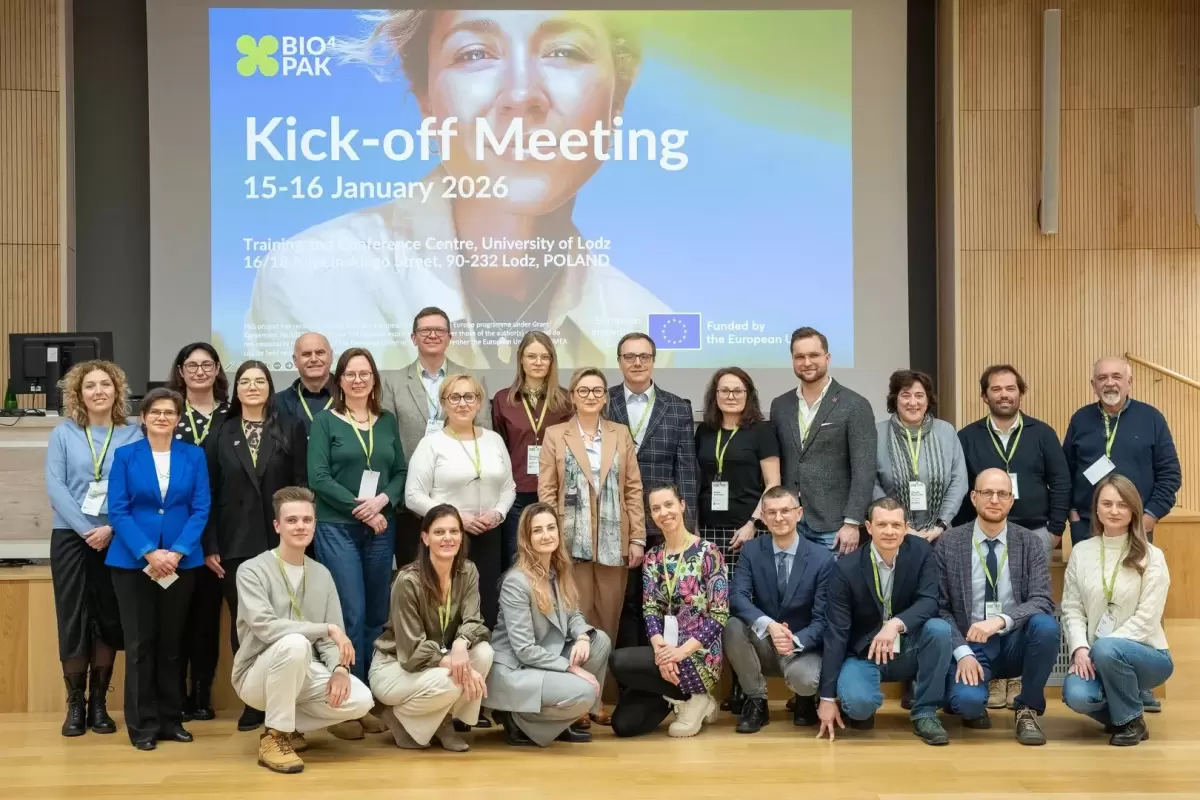
Bio4Pak explores bacteriophages as a new layer of food packaging protection
An international research consortium coordinated by the University of Lodz is developing a new generation of biodegradable food packaging designed to actively target pathogenic bacteria.
The Bio4Pak project combines bio-based and biodegradable packaging materials with bacteriophages, viruses that specifically infect bacteria, to create packaging capable of providing an additional biological layer of protection for food.
The initial research focuses on bacteriophages targeting Salmonella and their potential integration into packaging designed for fresh poultry meat.
Packaging becomes an active biological barrier
Conventional food packaging primarily protects products by creating physical barriers against oxygen, moisture, contamination and mechanical damage.
Bio4Pak takes a different approach by investigating whether packaging can also actively interact with microorganisms that threaten food safety.
The objective is not to replace established hygiene, processing or quality-control measures, but to provide an additional protective mechanism within the packaging system.
Bacteriophages target specific bacteria
Bacteriophages are viruses that infect specific bacterial species and can multiply within their target hosts.
Their high degree of specificity makes them fundamentally different from broad-spectrum antimicrobial substances that can affect a wider range of microorganisms.
Bio4Pak is investigating how this biological specificity could be incorporated into packaging without compromising the material's mechanical and barrier properties.
Controlled release is central to the technology
One of the most innovative elements of the project is the proposed mechanism for releasing the bacteriophages.
Researchers aim to develop systems in which phage release is triggered by signals associated with the target microorganisms.
This could allow the packaging to respond specifically to the presence of the bacteria it is designed to control rather than releasing the active component continuously.
Biodegradable materials form the packaging platform
The project is investigating bio-based and biodegradable materials for both flexible films and food trays.
These structures must meet the same fundamental requirements as conventional food packaging, including mechanical strength, appropriate gas permeability and reliable product protection.
The additional challenge is preserving the biological activity of the bacteriophages during material processing and throughout the period in which the packaging is expected to function.
Fresh poultry provides an initial test case
The first research model focuses on packaging for fresh poultry meat, where Salmonella represents an important food-safety concern.
The researchers are investigating whether bacteriophage-based packaging can provide an additional protective layer against contamination while maintaining the functionality required from the packaging itself.
The approach could eventually be extended to other food products and target microorganisms if the technology proves effective.
Food waste and food safety must be considered together
The project reflects an increasingly important principle in sustainable packaging development: reducing packaging material should not come at the expense of food protection.
Packaging that extends shelf life or reduces contamination can prevent food losses, potentially offsetting part of the environmental impact associated with producing the packaging.
Bio4Pak therefore combines two objectives that are often treated separately: developing biodegradable materials and maintaining effective protection of the food inside.
Technology remains at laboratory stage
Bio4Pak is currently working towards Technology Readiness Level 4, corresponding to validation of the technology under laboratory conditions.
This means the concept remains far from commercial deployment and still needs to demonstrate consistent performance under realistic food-processing, storage and distribution conditions.
Researchers will also need to address regulatory requirements, food-contact safety, manufacturing scalability and the stability of bacteriophages within the packaging structure.
Biological packaging creates new regulatory questions
Active packaging containing biological agents introduces regulatory considerations that differ from those associated with conventional packaging materials.
The identity, stability, activity and migration of the bacteriophages will need to be carefully characterised before such systems could be considered for commercial food applications.
Consumer acceptance will also be an important factor when biological technologies become part of packaging designed for direct contact with food.
Packaging could become responsive to contamination
If the Bio4Pak approach can be successfully developed, it could represent a significant change in the role of food packaging.
Instead of functioning only as a passive barrier, packaging could become a responsive system capable of detecting biological signals and activating a targeted protective mechanism.
The project illustrates how microbiology, materials science and packaging engineering are increasingly converging to create new approaches to food protection.
Next-generation packaging combines sustainability and functionality
The Bio4Pak project demonstrates that the future of sustainable packaging is unlikely to depend on material substitution alone.
Biodegradable structures will still need to protect food effectively, while new functional technologies could add capabilities such as antimicrobial activity and responsive protection.
If the technology can progress beyond laboratory validation, bacteriophage-enabled packaging could offer a new route towards combining lower environmental persistence with more active food-safety functionality.









Comments (0)