
A new study finds 87% of food-contact chemicals lack adequate safety data and identifies 38 priority groups for regulatory action.
Major safety data gaps identified in food packaging chemicals
A new peer-reviewed study has found that the vast majority of chemicals that can be used or detected in food packaging and other food-contact materials lack sufficient safety information to properly assess potential risks to consumers.
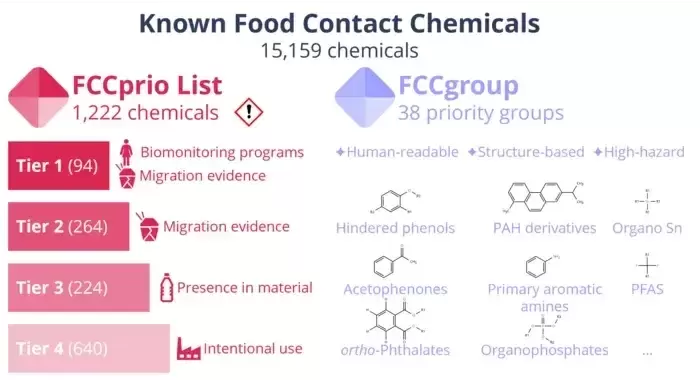
Researchers from the Food Packaging Forum Foundation analysed more than 15,000 food-contact chemicals and concluded that 87% do not have adequate publicly available hazard data covering the range of health effects required for a comprehensive safety assessment.
More than 1,200 chemicals already considered hazardous
The researchers identified 1,222 food-contact chemicals that are already known to present hazards to human health. However, more than 13,000 additional substances lack enough publicly available information to determine whether they can be considered safe.
The findings highlight a significant challenge for regulators and packaging manufacturers, as food-contact materials can contain complex mixtures of intentionally added substances, processing aids, impurities and degradation products.
Researchers identify 38 priority chemical groups
Rather than continuing to assess substances one by one, the researchers propose grouping chemicals according to structural similarities and known hazard characteristics. Their analysis identified 38 priority groups containing a particularly high proportion of chemicals already associated with health concerns.
These groups include ortho-phthalates, PFAS, alkyl phenols, organophosphates, isocyanates and primary aromatic amines, among others. In total, 3,547 food-contact chemicals fall within the identified priority groups.
Grouping could prevent regrettable substitutions
The approach is designed partly to address the problem of regrettable substitution, where a restricted chemical is replaced with a structurally similar compound that has less available safety data but may ultimately present comparable risks.
Bisphenol A provides a well-known example, with alternatives such as bisphenol F and other related compounds entering applications as manufacturers sought replacements. Assessing related substances as groups could allow regulators to identify these risks earlier.
Current regulatory systems described as inefficient
The study argues that current food-contact regulations in Europe and North America rely heavily on chemical-by-chemical evaluation. With thousands of substances lacking complete toxicity data, this process can make comprehensive regulatory assessment difficult and slow.
The authors suggest that group-based prioritisation could help authorities identify substances requiring restrictions, phase-outs or additional testing without waiting for complete datasets to become available for every individual chemical.
New tools aim to support manufacturers and regulators
Alongside the research, the Food Packaging Forum has published an evidence-based priority list of known hazardous food-contact chemicals and developed a digital screening tool called FCCgroup.
The system allows users to check whether substances belong to any of the 38 priority groups. The researchers say the approach could help packaging manufacturers identify potential chemicals of concern earlier in material development and prepare for possible future regulatory restrictions.
Chemical safety becomes a growing packaging priority
The study adds to increasing scrutiny of chemicals used in food-contact applications as regulators reconsider substances such as PFAS and bisphenols. Material recyclability alone is also increasingly being recognised as insufficient if hazardous chemicals remain present in circular material streams.
For packaging producers, the findings reinforce the need for greater transparency throughout material supply chains and more comprehensive knowledge of coatings, inks, adhesives, additives and other substances that can form part of finished food-contact packaging.
Research could influence future packaging regulation
The researchers argue that better chemical grouping could provide a faster route towards safer food-contact materials while scientific testing catches up with the thousands of substances already in commercial use.
As regulators increasingly focus on chemical safety alongside recyclability and environmental performance, packaging manufacturers may face stronger expectations to demonstrate not only what materials their packs contain, but also whether the individual substances within those materials have been adequately assessed.








Comments (0)