
Amazon develops stretchable, heat-sealable paper with a water-soluble coating to replace plastic delivery bags in automated fulfillment.
Amazon develops stretchable paper to replace plastic delivery bags
Amazon is developing a new type of stretchable paper designed to replace plastic delivery packaging while maintaining the flexibility, strength and processing performance required by automated fulfilment operations.
The material combines a specially engineered paper structure with a water-soluble coating, allowing it to stretch considerably more than conventional kraft paper while remaining suitable for high-speed packaging processes.
The development forms part of Amazon’s broader effort to replace single-use plastic delivery packaging with paper-based alternatives that can be recycled through household collection systems.
Paper is engineered to stretch around products
Conventional kraft paper has limited elasticity, making it difficult to use in packaging systems that need to conform tightly around products.
Amazon’s new material is designed to provide substantially greater flexibility, with the company reporting that it can stretch to roughly two or three times the flexibility of standard kraft paper.
This characteristic allows the material to adapt to different product shapes while reducing the need for oversized packaging.
Water-soluble coating adds functionality
The paper incorporates a water-soluble coating developed to provide additional functional properties while maintaining compatibility with paper recycling.
The coating contributes to the material’s resistance and enables the packaging to withstand conditions that would otherwise be challenging for an uncoated paper structure.
Amazon is also investigating how the material behaves during recycling to ensure that the coating does not prevent fibre recovery.
Heat sealing allows automated production
One of the key challenges in replacing plastic delivery bags is maintaining compatibility with automated packaging equipment.
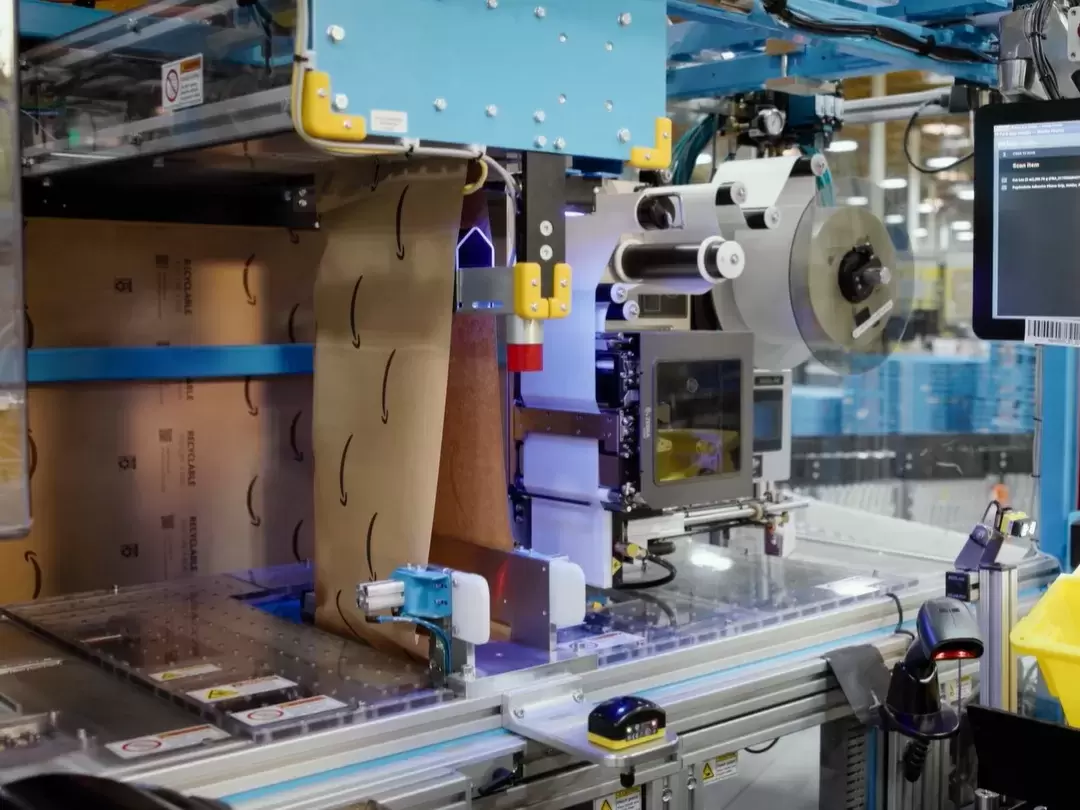
Amazon has developed paper structures that can be heat sealed, allowing machines originally designed around plastic packaging processes to be adapted for paper.
This approach avoids replacing entire packaging lines and makes it easier to introduce paper alternatives across existing fulfilment infrastructure.
Made-to-fit packaging reduces excess material
The stretchable paper is being combined with Amazon’s made-to-fit packaging technology, which uses sensors to determine the dimensions of individual products and creates packaging around the item.
More accurate sizing reduces empty space and can lower the amount of material required for each shipment.
The approach also reduces the need to transport unnecessary packaging volume through the delivery network.
New generation of machines expands paper packaging
Amazon has continued to modify automated machines that previously produced plastic delivery bags so they can manufacture made-to-fit paper alternatives.
According to Amazon, a new generation of the technology can package approximately 20% more products in paper bags by accommodating a wider range of product sizes.
The systems are being deployed across fulfilment operations in North America, Europe, Japan and Australia.
288 million plastic bags avoided in North America
Amazon says its transition to made-to-fit paper bags helped avoid approximately 288 million plastic delivery bags in North America during 2025.
The figure illustrates the potential impact of packaging-machine redesign when an alternative material can be integrated into high-volume fulfilment operations.
It also demonstrates that replacing plastic packaging at Amazon requires changes not only to materials but to the equipment used to manufacture and apply those materials.
Paper must match plastic on performance
The development highlights why replacing plastic packaging is technically more complicated than simply selecting paper as a different substrate.
Delivery packaging needs to withstand handling, compression, moisture and transport while protecting the product inside.
At the same time, it must be lightweight, easy to seal and capable of being produced at the speed required by large fulfilment centres.
Recyclability is designed into the system
Amazon is targeting household-recyclable paper packaging rather than solutions that require specialist collection systems.
The company has already transitioned its European delivery network away from single-use plastic delivery packaging and continues to expand paper-based formats in other regions.
The new stretchable material is intended to extend this transition into applications where conventional paper has not provided enough flexibility or protection.
E-commerce packaging becomes increasingly engineered
The development illustrates how e-commerce packaging is evolving from relatively simple boxes and mailers into highly engineered systems combining materials, sensors, automation and software.
For Amazon, the objective is not simply to replace plastic but to create packaging that is correctly sized, efficient to manufacture and compatible with existing fulfilment processes.
This integrated approach could become increasingly important as e-commerce operators seek to reduce packaging waste while maintaining the speed and reliability required by large-scale distribution networks.








Comments (0)