
BEUMER launches robotpick, using computer vision and adaptive gripping to automate up to 99.9% of bulk parcel picking and singulation.
BEUMER automates bulk parcel picking with robotic vision
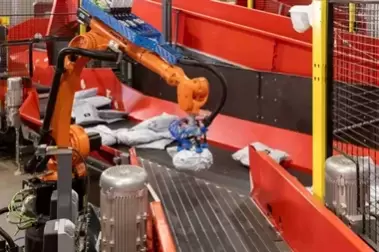
BEUMER Group has launched robotpick, an autonomous robotic system designed to automate the picking and singulation of mixed parcels before they enter automated sorting and induction systems.
The solution combines computer vision, robotic control and adaptive vacuum gripping to identify individual parcels within bulk flows and place them into a controlled, continuous stream.
BEUMER says the system can automate up to 99.9% of the bulk parcel handling process under the appropriate parcel mix and operating conditions.
Computer vision identifies mixed parcels
Bulk parcel flows can contain boxes, polybags, carton bags and envelopes in different sizes, shapes and orientations.
BEUMER robotpick uses computer vision to analyse each parcel and identify an appropriate picking point before the robot attempts to remove it from the bulk stream.
The system then dynamically adjusts the robot movement and vacuum gripping strategy according to the characteristics of the individual parcel.
Adaptive gripping handles different packaging formats
The ability to handle heterogeneous parcels is critical in e-commerce logistics, where packaging formats can vary significantly within the same shipment flow.
Fixed picking patterns are less effective when parcel dimensions, materials and orientations change continuously.
Robotpick instead adapts its picking strategy to the parcel being handled, allowing different packaging formats to pass through the same automated process.
Up to 1,600 parcels per hour per robot cell
Each robot cell can process up to 1,600 parcels per hour, depending on the parcel mix and operating conditions.
Standard configurations can include between one and four independently operating robot cells on a single bulk feeding line.
The modular architecture allows operators to increase capacity as parcel volumes grow without having to redesign the entire handling system.
Failed picks are automatically recirculated
Not every parcel can be successfully picked on the first attempt, particularly when items are tightly packed or positioned in difficult orientations.
Robotpick automatically returns unpicked or dropped parcels to the bulk flow, allowing the system to make another attempt rather than requiring manual intervention.
This recirculation capability helps maintain a continuous supply of singulated parcels to downstream sorting equipment.
Automation connects directly to parcel sortation
The robot cells are integrated with downstream induction and sortation systems, transforming a disordered bulk stream into a more predictable flow of individual parcels.
This removes one of the labour-intensive stages that can otherwise limit the performance of automated parcel hubs.
By stabilising the flow before sorting, the system can also help downstream automation operate more consistently.
Packaging diversity becomes an automation challenge
The growth of e-commerce has increased the diversity of packaging entering parcel networks.
Rigid boxes increasingly coexist with flexible mailers, padded envelopes and other lightweight formats, creating challenges for automated handling systems designed around more uniform objects.
Computer vision and adaptive robotic gripping allow the automation system to respond to this variability instead of requiring each packaging format to follow a predefined handling pattern.
Modular robotics support incremental investment
The independent robot-cell architecture allows operators to scale capacity progressively.
Individual cells can be stopped for maintenance or software updates while other cells continue operating, reducing the impact of service interventions on overall throughput.
This modularity also allows investment to be aligned with parcel volumes rather than requiring full capacity from the beginning.
AI-driven handling moves deeper into logistics
The development illustrates how computer vision and intelligent robotics are moving beyond warehouse picking into the physical handling of consumer shipments.
Rather than identifying products for order fulfilment, the system identifies parcels based on their physical characteristics and determines how they can be safely picked and positioned.
This creates a new application for AI-driven robotics within the packaging and distribution chain.
Parcel automation targets labour-intensive handling
Bulk parcel singulation is traditionally dependent on manual labour because of the variability of incoming shipments.
Automating the process can reduce repetitive handling requirements while creating a more predictable flow for automated sorting systems.
For large e-commerce and parcel operators, the combination of higher automation and scalable capacity could become increasingly important as shipment volumes and packaging diversity continue to grow.






Comments (0)