
Constantia Flexibles and Evonik win the German Packaging Award for TEGO Res 1100, a deinking solution improving flexible packaging recyclability.
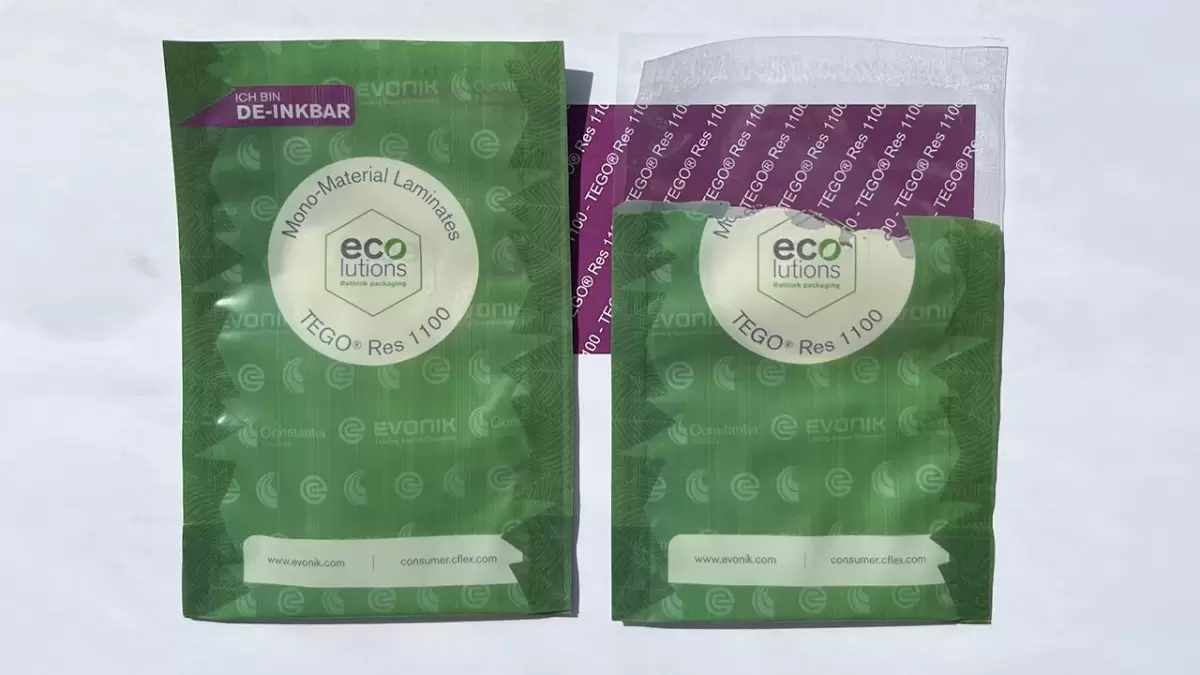
Constantia and Evonik recognised for deinking innovation
Constantia Flexibles and Evonik have received the German Packaging Award 2026 in the sustainability category for TEGO Res 1100, a technology designed to improve the removal of printing inks from flexible plastic packaging during mechanical recycling.
The solution addresses one of the less visible challenges in flexible packaging recycling: residual printing inks can remain within recycled material streams and affect colour, odour and overall recyclate quality.
Co-binder integrates into existing ink systems
TEGO Res 1100 was developed by Evonik as a co-binder for solvent-based printing inks. The material can be incorporated directly into existing ink formulations without requiring converters to change the packaging structure or fundamentally alter established printing processes.
This makes the technology easier to adopt because recyclability improvements can be introduced through ink chemistry rather than through a complete redesign of the flexible packaging laminate.
Deinking supports cleaner recyclates
During mechanical recycling, printed flexible packaging is washed and processed into secondary polymer feedstock. Effective removal of printing inks can help reduce contamination and improve the visual and technical quality of the resulting recyclate.
Cleaner recycled material can potentially open additional applications and support the wider objective of keeping polyethylene and polypropylene packaging within higher-value recycling loops.
Constantia validates performance on flexible laminates
Constantia Flexibles evaluated TEGO Res 1100 across several flexible packaging structures, including EcoLamPlus, its mono-material polyethylene laminate.
The trials indicated that the use of the deinking co-binder did not compromise printability, ink adhesion, sealing performance or abrasion resistance, all of which remain critical for commercial flexible packaging production.
Technology extends across PE and PP structures
Beyond EcoLamPlus, the technology can be used with other polyethylene-based structures including EcoLam and EcoLamHighPlus, as well as polypropylene-based EcoVer solutions.
This broad compatibility gives converters the possibility of using the same deinking concept across multiple recyclable flexible packaging platforms rather than limiting it to a single substrate configuration.
Ink chemistry becomes part of design for recycling
Flexible packaging recyclability is often discussed mainly in terms of mono-material structures, barrier layers and adhesives, but inks can also influence the quality of recycled output.
Improving deinkability therefore adds another dimension to design-for-recycling strategies by addressing what happens to printed decoration once the pack enters a mechanical recycling process.
Food-contact applications still require further work
Evonik and Constantia stress that cleaner recyclate does not automatically mean suitability for food-contact applications. These uses remain subject to separate regulatory, safety and technical requirements.
Even so, improving the purity and quality of recycled polymers can create a stronger foundation for future developments and help expand the range of applications available to mechanical recyclates.
Collaboration began in 2024
The two companies have been working together on the project since August 2024, combining Evonik’s expertise in ink additives with Constantia Flexibles’ experience in recyclable laminate structures and converting performance.
The collaboration demonstrates how recyclability improvements increasingly depend on coordination between material suppliers, ink formulators, converters and recyclers rather than on isolated changes to a single component.
German Packaging Award highlights circular design
The German Packaging Award 2026 recognised 36 winners across ten categories, with TEGO Res 1100 selected in the sustainability category.
The award ceremony will take place on 19 November 2026 in Berlin, where the Gold Awards will also be announced.
Deinking could improve flexible packaging circularity
As Europe introduces stricter recyclability requirements and higher recycled-content targets, improving the quality of mechanically recycled flexible plastics is becoming increasingly important.
By enabling more effective ink removal without changing packaging structures or printing workflows, TEGO Res 1100 offers a practical route to improving recyclate quality while keeping production processes familiar to converters.





Comments (0)