
FOLI challenges traditional condiment packaging with sculptural interlocking glass bottles designed to combine functionality, collectability and shelf impact.
FOLI challenges traditional condiment packaging
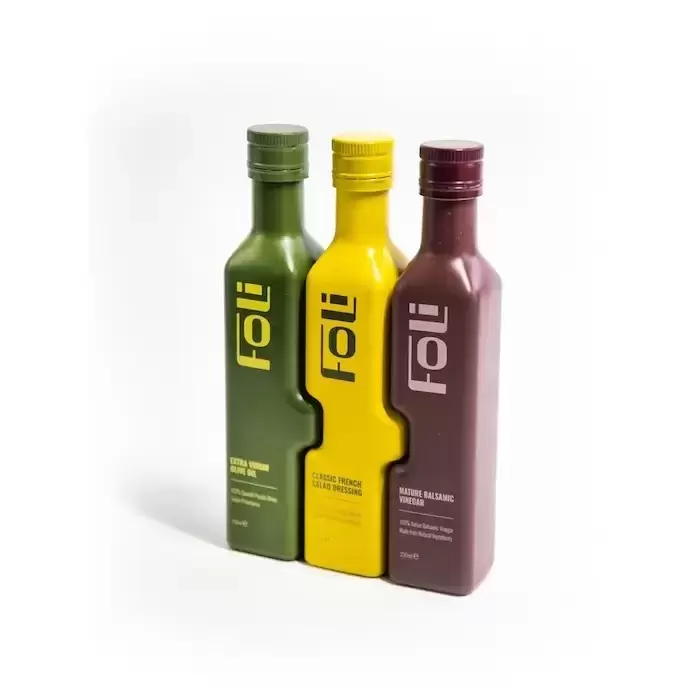
FOLI has entered the premium food market with a distinctive packaging system that moves away from conventional condiment bottle design. Founded by Nohra Currie, the brand combines extra virgin olive oil, French salad dressing and mature balsamic vinegar from Modena in a set of sculptural glass bottles designed to interlock with one another.
The concept emerged after Currie became dissatisfied with the quality and presentation of existing salad dressings. Rather than starting with a packaging brief, she first focused on sourcing ingredients and developing products she wanted to use herself. Packaging only became a priority once the three-product range had taken shape.
Three bottles form a single visual system
The proprietary registered design allows the three bottles to function individually while also connecting physically to create a single composition. Different pastel colours distinguish each product, while the interlocking structure encourages consumers to perceive the range as a collection rather than as separate SKUs.
The system has also been designed to expand. Additional bottles can be developed to sit between the existing forms, allowing future products to extend the collection without changing its visual architecture.
This approach has created an unusual form of consumer interaction. According to FOLI, shoppers frequently pick up and rearrange the bottles in stores, while some customers keep the packaging on display after purchase, refill the containers or repurpose them as decorative objects.
Manufacturing the concept proved challenging
Turning the design into a commercially viable package was more difficult than developing the initial idea. Currie estimates that she approached around 100 manufacturers across the UK, Europe and Asia before finding a supplier prepared to produce the bottles.
Aluminium was initially considered but could not achieve the required geometry. Other manufacturers raised concerns around stability, breakage, handling and pouring performance. Despite these objections, the final glass design was successfully brought into production.
The technical challenge highlights the tension that can arise between established manufacturing conventions and more experimental structural packaging concepts. FOLI's development process ultimately required finding a supplier willing to test an unconventional format rather than adapting the concept to existing bottle standards.
Packaging becomes part of the purchasing experience
The interlocking design has also influenced purchasing behaviour. FOLI initially launched the products as a complete set while offering individual bottles for replenishment, but retailers found that some consumers would purchase one bottle before returning to complete the collection.
This gives the structural design a commercial role beyond shelf differentiation. Each bottle visually suggests its relationship with the rest of the range, encouraging repeat purchases and reinforcing the brand as an expandable system.
Launched in 2026, FOLI has already secured distribution through Harrods and a growing network of independent retailers, while receiving recognition across food, sustainability and packaging awards.
Material choices support longevity and recyclability
Despite the emphasis on visual impact, the company says functional considerations remain important. Printing directly onto the glass helps protect the contents from light while reducing the visibility of oil marks that can appear on transparent bottles.
The packaging uses glass bottles, lightweight recyclable aluminium caps and recyclable cardboard outer packaging. The ability to refill or repurpose the bottles may also extend their useful life beyond the original product.
FOLI's approach demonstrates how structural packaging can become an integral part of brand identity, consumer engagement and product strategy. By questioning established assumptions around condiment packaging, the company has created a format designed not only to contain the product, but also to remain visible and desirable on the table after purchase.





Comments (0)