
Korean researchers use hemp hurd waste to strengthen biodegradable TPS/PBAT films while improving moisture and oxygen barrier performance.
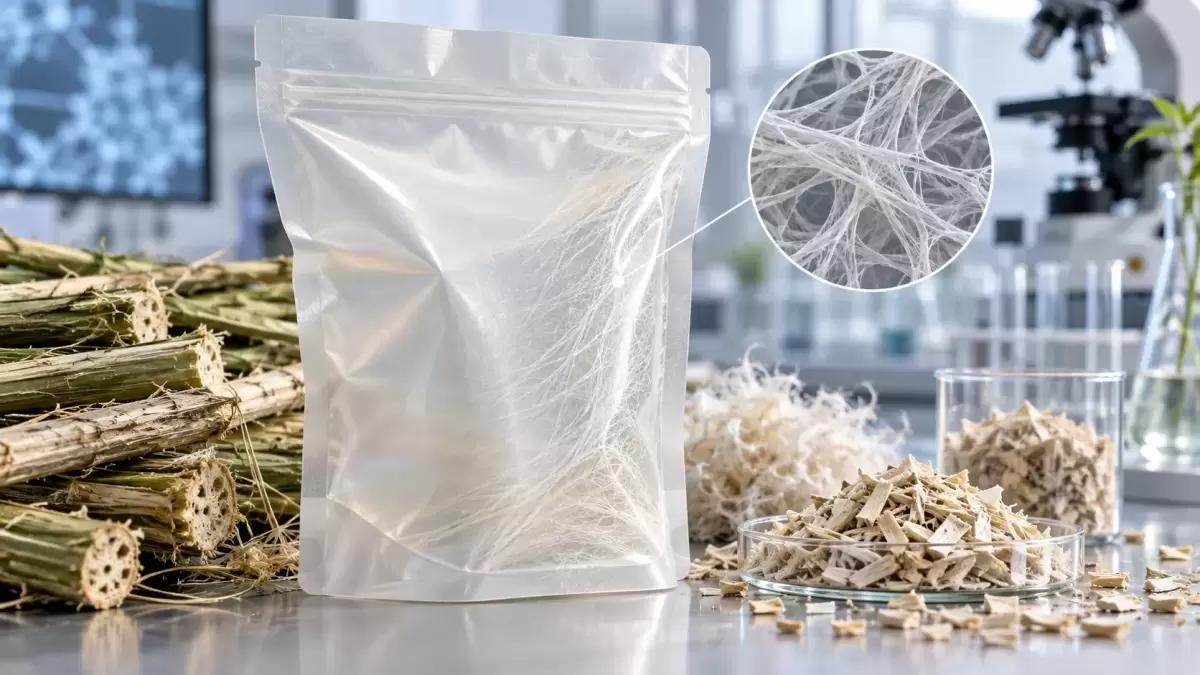
Hemp processing waste strengthens biodegradable packaging films
Researchers in South Korea have developed a new way to use industrial hemp waste as a reinforcing material for biodegradable plastic films, improving mechanical strength while also enhancing moisture and oxygen barrier performance.
The research team at the Korea Research Institute of Chemical Technology (KRICT) extracted cellulose from hemp hurd, the woody inner core of industrial hemp stalks, and converted it into microfibrillated cellulose for use as a bio-based filler.
The approach could provide a new use for a large agricultural residue while improving the performance of biodegradable packaging materials based on thermoplastic starch and PBAT.
Hemp hurd represents a largely underused biomass stream
Industrial hemp stalks contain an outer fibre layer that can be used for textiles and other applications, while the woody inner core, known as hemp hurd, has traditionally had fewer high-value uses.
The hurd can account for roughly 70% of the stalk by weight, making it a potentially significant source of cellulose.
Instead of using commercial wood or cotton pulp as the starting material for reinforcement, the KRICT researchers are using this agricultural residue to produce microfibrillated cellulose.
Cellulose reinforcement improves biodegradable films
The researchers incorporated the hemp-derived cellulose into films made from thermoplastic starch and poly(butylene adipate-co-terephthalate), or PBAT.
These biodegradable polymers are already being investigated for packaging and agricultural film applications, but their mechanical strength and moisture resistance can limit their practical use.
Adding cellulose microfibrils creates a reinforcing network within the polymer matrix, allowing mechanical stress to be distributed more effectively across the film.
New drying process prevents fibre aggregation
A major technical challenge is that cellulose microfibrils tend to collapse and form strong aggregates when they are dried.
This phenomenon, known as hornification, can destroy the fine fibrillar structure needed for effective reinforcement.
Freeze-drying and spray-drying can reduce aggregation, but these methods require additional energy and specialised equipment, making them less attractive for large-scale production.
The KRICT team instead developed a process based on controlling the moisture content of the cellulose during milling and drying, combined with surface treatment using alkyl ketene dimer.
Conventional oven drying becomes possible
The researchers identified the fibre saturation point of the hemp-derived cellulose and maintained sufficient moisture during processing to prevent excessive hydrogen bonding between neighbouring microfibrils.
They then used AKD to introduce hydrophobic alkyl chains onto the cellulose surface, creating additional steric separation between the fibrils.
This combination allowed the fine structure to be preserved during conventional oven drying rather than requiring energy-intensive freeze-drying.
Tensile strength increases by 26.2%
The performance improvement was significant when the processed cellulose was incorporated at 10% by weight into the TPS/PBAT film.
Cellulose prepared using conventional drying increased tensile strength by only 1.5%, while the cellulose produced through the new moisture-control and surface-treatment process increased tensile strength by 26.2%.
The result demonstrates the importance of preserving the microfibrillar structure rather than simply adding untreated agricultural fibres to a biodegradable polymer.
Barrier performance also improves
The reinforced film showed improvements beyond mechanical strength.
Water vapour transmission was reduced by approximately 17%, while oxygen transmission decreased by around 9% compared with the corresponding unreinforced material.
These improvements are particularly relevant to packaging because moisture and oxygen barriers influence product stability and shelf life.
Agricultural waste becomes a functional packaging ingredient
The development illustrates a broader approach to biomass utilisation in which agricultural residues are transformed into functional components rather than simply being used for low-value energy recovery.
Hemp hurd could provide a renewable source of cellulose reinforcement while simultaneously reducing the amount of agricultural waste requiring disposal or alternative treatment.
The same approach could potentially be extended to other cellulose-rich residues, including soybean stalks and rice straw.
Scale-up remains the next challenge
The research is still at the development stage and further work will be required before the material can be considered for commercial packaging applications.
Future studies will need to assess large-scale processing, consistency of agricultural feedstocks, food-contact suitability, sealing behaviour, shelf-life performance and end-of-life conditions.
The economics of collecting and processing hemp hurd will also determine whether the material can compete with established cellulose sources and other biodegradable reinforcement technologies.
Waste-derived reinforcement could expand biodegradable packaging
The KRICT research demonstrates how improving the internal structure of a biodegradable film can address some of the performance limitations that have restricted wider adoption.
Combining biodegradable polymers with agricultural waste-derived cellulose could provide a route towards films that use renewable resources while delivering stronger mechanical and barrier performance.
The next step will be determining whether the laboratory-scale improvements can be translated into reliable industrial production and packaging formats.





Comments (0)