
P&G, LasX and Mondi advance high-speed laser marking as a label-free packaging technology for mono-material design and digital decoration.
Laser marking expands beyond coding into full packaging decoration
Laser marking technology is moving beyond traditional applications such as expiry dates and batch codes as packaging manufacturers explore its use for high-resolution graphics, consumer information and branding directly on containers.
Recent advances in laser frequency, scanner technology and digital controls are enabling systems to operate at industrial packaging speeds while covering much larger areas of a pack.
This development is positioning laser marking as a potential alternative to pressure-sensitive labels, shrink sleeves and conventional direct printing in selected applications.
P&G scales laser marking into commercial production
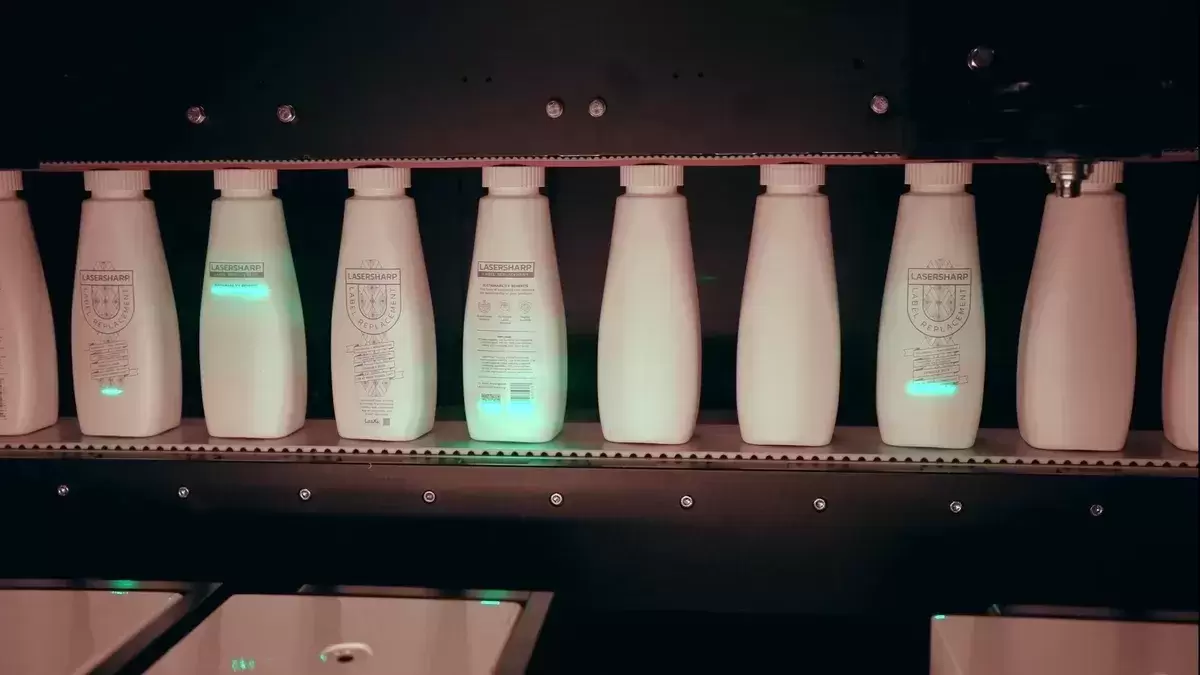
Procter & Gamble has been working with LasX Industries since 2021 to develop direct-to-package laser marking capable of operating at FMCG production speeds.
The companies commercialised the technology under the Lazrmark and LaserSharp brands and have already deployed it on polypropylene caps used for Tide laundry detergent.
The laser creates dosing information and branding directly on the closure surface, eliminating the need for additional printed components while preserving the mono-material construction of the cap.
Production speeds exceed 400 bottles per minute
LasX says its current systems can process more than 400 bottles per minute depending on the package geometry and complexity of the artwork.
Modern high-frequency pulse lasers can operate millions of times per second, allowing detailed graphics and text to be produced at speeds previously considered impractical for mass-market packaging.
The company’s controllers can support frequencies of up to 10 MHz, combining rapid pulsing with scanner systems that direct the beam across the packaging surface.
Digital workflow removes labels, inks and adhesives
Unlike traditional decoration methods, laser marking does not require label stock, release liners, printing inks or adhesives.
Graphics are generated digitally and applied directly to the package surface, allowing artwork files to be changed quickly without replacing printing plates or label inventories.
This can simplify packaging supply chains while reducing waste associated with obsolete printed materials when branding, language or regulatory information changes.
Mondi explores laser marking for flexible packaging
Mondi has also introduced a concept using laser marking on flexible packaging structures intended for applications including bag-in-box and e-commerce packaging.
The approach removes the need for conventional decorative printing and printing plates while enabling information and graphics to be added later in the packaging production process.
This could support shorter lead times and greater flexibility for smaller production runs or multiple product variants.
Technology supports variable and serialised information
Because the process is digitally controlled, laser marking can also support variable data such as serial numbers, unique identifiers and QR codes without changing physical printing equipment.
This capability could become increasingly important as packaging adopts more traceability, authentication and Digital Product Passport functions.
Individual packs can potentially receive unique information at production speed, creating additional opportunities for supply-chain tracking and consumer engagement.
Surface chemistry determines how the mark is created
Laser decoration does not rely on a single physical mechanism. Depending on the packaging substrate, the beam may remove material, darken the surface, create microscopic foaming or modify the crystalline structure of the polymer.
The technology can be applied to polymers, fibre materials, glass and metals, although rigid plastic packaging currently represents one of the most established applications.
Manufacturers must therefore match wavelength, laser power and processing parameters to the specific material and desired visual effect.
Label-free decoration could simplify recycling
Removing labels and sleeves can also improve packaging recyclability where these secondary components would otherwise introduce incompatible materials or adhesives.
Laser marking allows information to remain permanently integrated into the primary package without adding another material layer.
For mono-material bottles and closures, this can simplify sorting and recycling while reducing overall packaging material consumption.
Laser marking becomes another tool for packaging designers
P&G does not expect the technology to replace every conventional label or printing process. Instead, it sees laser marking as an additional decoration option that can be selected according to material, production speed and design requirements.
As equipment performance continues to improve, the technology could expand into larger areas of consumer packaging where high-resolution graphics, permanent marking and rapid digital changeovers are required.
The transition from simple coding to high-speed packaging decoration suggests that lasers could increasingly become part of mainstream packaging production rather than remaining limited to identification and traceability tasks.







Comments (0)