
Mexico’s metal packaging sector advances circularity through high recycling rates, recycled content and more efficient material use.
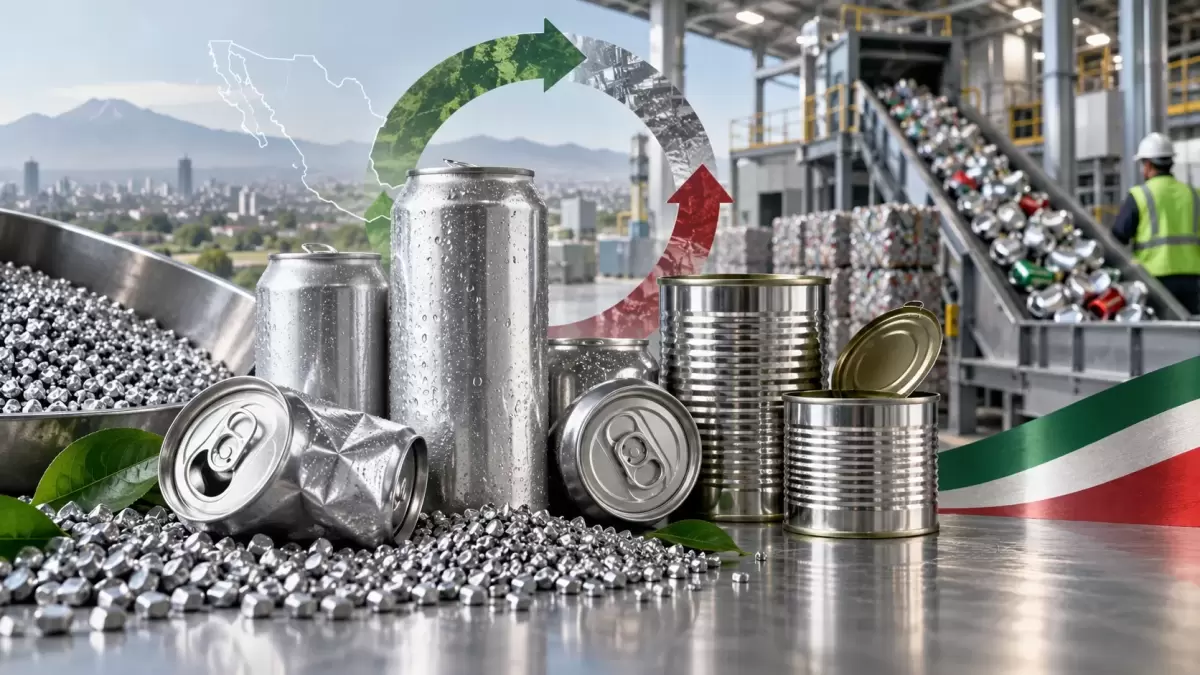
Mexico strengthens circularity across metal packaging
Mexico’s metal packaging industry is increasing its focus on circular production models as manufacturers seek to recover more aluminium and steel, increase recycled content and reduce the amount of virgin material used in cans and containers.
The sector benefits from the inherent recyclability of metals, which can be repeatedly reprocessed without losing their fundamental properties. This makes aluminium and steel particularly suitable for closed-loop packaging systems where recovered material can return to new packaging production.
For Mexico, the challenge is increasingly shifting from proving that metal can be recycled to ensuring that collection, sorting and domestic reprocessing systems capture as much material as possible.
Aluminium cans support high-value recycling loops
Aluminium beverage cans are one of the strongest examples of circular packaging because recovered material retains significant economic value and can be efficiently separated from mixed waste streams.
Mexico has historically achieved high recovery rates for aluminium beverage cans, creating a strong secondary raw-material market and encouraging informal and formal collection networks.
The ability to recycle aluminium back into new cans also provides substantial energy savings compared with producing primary aluminium, helping manufacturers reduce the carbon footprint associated with packaging production.
Lightweighting reduces demand for primary materials
Alongside recycling, manufacturers are continuing to reduce the amount of metal required for each package.
Improvements in alloy performance, forming technology and can design have allowed packaging producers to manufacture thinner and lighter containers while maintaining the mechanical strength required during filling, transport and retail handling.
When deployed across high-volume beverage and food categories, relatively small reductions in material thickness can translate into significant savings in metal consumption and transport weight.
Steel packaging remains important in food applications
Steel cans also contribute to circular packaging systems, particularly across preserved foods, aerosols and industrial applications.
The magnetic properties of steel make it comparatively straightforward to separate from mixed waste streams, while its durability and barrier properties allow packaged foods to remain stable for extended periods without refrigeration.
This combination of recyclability and product protection can reduce both packaging waste and food loss across supply chains.
Domestic recycling capacity influences real circularity
High collection rates alone do not guarantee closed-loop recycling. The environmental and economic value of metal packaging also depends on where recovered material is processed and what it becomes after recycling.
Keeping aluminium and steel within domestic or regional manufacturing systems can reduce dependence on virgin raw materials while supporting local recycling infrastructure and industrial employment.
This is becoming increasingly important as global demand for secondary metals rises across packaging, automotive, construction and energy applications.
Brands increasingly consider recycled content and design
Packaging producers are also working more closely with food and beverage companies to increase recycled content while improving package efficiency.
Design choices including downgauging, simplified components and compatibility with existing sorting systems can determine whether packaging remains within high-value recycling loops.
For beverage cans in particular, maintaining material quality is essential if recovered aluminium is to return to can production rather than being downcycled into lower-value applications.
Metal packaging remains central to Mexico’s circular economy
Mexico’s established recycling ecosystem gives metal packaging a strong position as brands and manufacturers face increasing pressure to reduce resource use and improve packaging recovery.
The next stage of circularity will depend on combining high collection rates with efficient domestic reprocessing, greater recycled content and continued lightweighting.
For the metal packaging sector, this creates an opportunity to move beyond recyclability claims and demonstrate measurable closed-loop performance across the complete material lifecycle.









Comments (0)