
Rapids Paper + Packaging expands ECOVA with heat-sealable barrier papers designed to replace plastic in selected flexible packaging applications.
ECOVA expands paper-based alternatives for flexible packaging
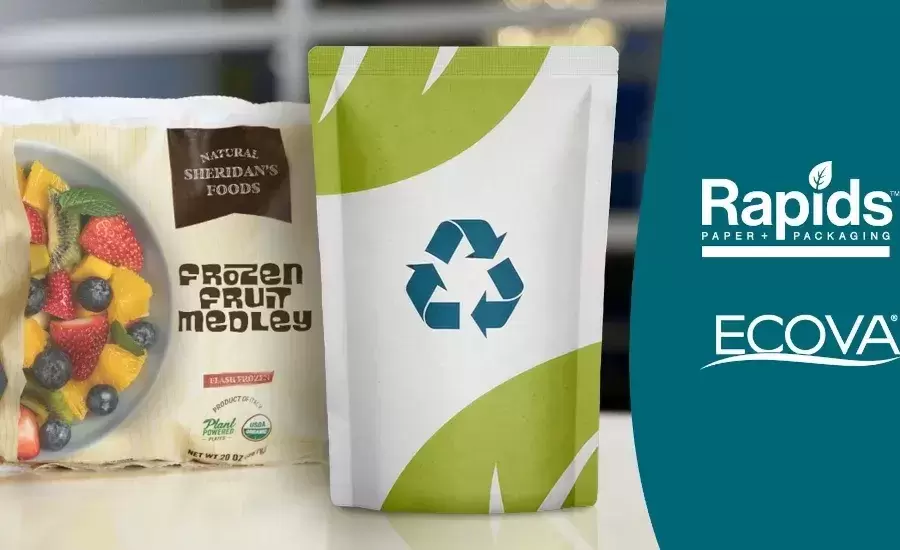
Rapids Paper + Packaging has expanded its ECOVA portfolio with a new line of heat-sealable functional barrier papers designed to help brands reduce plastic use in selected flexible packaging applications.
The new ECOVA Barrier range combines paper-based structures with moisture protection and heat-sealing capabilities, addressing two of the main technical requirements that have limited the adoption of paper in flexible packaging.
The solution targets food and consumer goods applications where packaging must provide product protection while supporting more circular material strategies.
Barrier performance enables wider paper applications
Paper-based packaging offers renewable fibre content and established recycling pathways, but untreated paper lacks the resistance required for many flexible packaging applications.
Moisture, grease and liquid exposure can compromise paper performance, meaning additional functional layers are often required.
ECOVA Barrier has been developed to provide increased resistance to moisture vapour transmission, with Rapids reporting an MVTR below 0.7 g/100 in²/day, or less than 10 g/m²/day.
Heat sealing allows paper to run like flexible packaging
One of the main challenges for paper-based flexible packaging is achieving reliable sealing performance at industrial speeds.
The ECOVA platform uses patented Paperlock technology to provide heat-sealable functionality, allowing paper structures to operate on existing flexible packaging equipment.
The materials are compatible with vertical form-fill-seal, horizontal form-fill-seal and pouching systems, reducing the need for major equipment changes during adoption.
Existing production infrastructure supports adoption
Compatibility with existing machinery is becoming increasingly important as brands search for alternatives to conventional plastic packaging.
New materials must not only meet sustainability objectives but also integrate into established filling, sealing and converting operations.
By allowing brands to use existing packaging equipment, ECOVA aims to reduce the operational disruption associated with transitioning to paper-based flexible formats.
Flexible packaging remains a major sustainability challenge
Flexible packaging is widely used because it combines low material consumption with strong product protection and transport efficiency.
However, many conventional flexible formats rely on complex plastic structures that are difficult to recycle.
This has increased interest in alternatives based on paper, compostable materials and simplified mono-material structures.
Paper alternatives must maintain product protection
The development highlights one of the central challenges of sustainable packaging: reducing plastic use without compromising packaging performance.
Food and consumer goods require packaging that can protect against environmental factors, maintain shelf life and operate reliably throughout production and distribution.
Functional barriers and advanced paper treatments are therefore becoming increasingly important in enabling paper to move into applications traditionally dominated by plastic.
Commercial availability moves paper packaging beyond prototypes
Many sustainable packaging concepts remain limited to pilot projects because they struggle to achieve industrial performance or cost competitiveness.
Rapids Paper + Packaging positions ECOVA Barrier as a commercially available solution, offering rollstock and pre-made pouch formats supported by technical trials and scale-up assistance.
This approach reflects a broader movement in packaging innovation: moving from material experimentation towards solutions that can be adopted within existing supply chains.
Functional papers could accelerate flexible packaging transition
The expansion of ECOVA demonstrates how paper-based flexible packaging is evolving from simple substitution towards engineered performance.
Future adoption will depend on whether these materials can consistently deliver the barrier, sealing and processing characteristics required by brands and converters.
As regulatory pressure increases around plastic reduction and recyclability, functional paper solutions may become an increasingly important pathway for selected flexible packaging applications.








Comments (0)