
RDM Group expands its recycled fibre packaging portfolio, combining recycled cartonboard, barrier performance and circular design for European markets.
RDM Group strengthens recycled fibre packaging strategy
RDM Group is expanding its role in fibre-based packaging as brands and converters seek higher recycled content, stronger recyclability and packaging structures capable of meeting increasingly demanding European circularity requirements.
The company specialises in cartonboard produced from recycled fibres and is positioning these materials across food, beverage, household and consumer goods applications where packaging must combine environmental performance with printability, converting efficiency and product protection.
Recycled cartonboard remains central to the portfolio
RDM Group has built its packaging strategy around recovering paper and board fibres and returning them to high-value packaging applications.
Using recycled fibre can reduce demand for virgin raw materials while supporting established European collection and recycling systems. For converters, the challenge is ensuring that secondary fibres continue to deliver the consistency required for printing, folding, cutting and high-speed packing operations.
Barrier performance expands fibre applications
One of the main limitations of conventional recycled cartonboard is its suitability for products requiring protection against grease, moisture or migration.
RDM has therefore been developing coated structures that extend the range of applications available to recycled board. These solutions are intended to reduce dependence on more complex plastic or aluminium laminates while maintaining the barrier properties required by food and consumer products.
Partnerships accelerate material development
The group has increasingly worked with coatings and materials specialists to improve the performance of recycled fibre packaging.
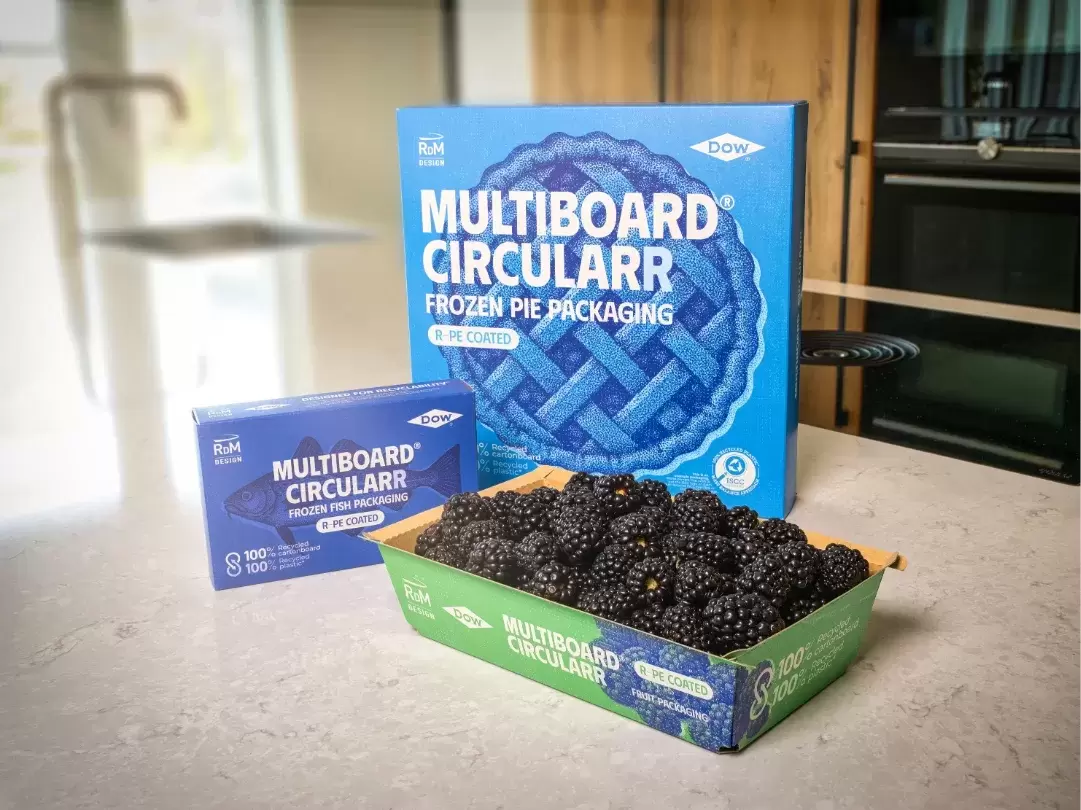
A recent collaboration with Dow combined recycled cartonboard with a barrier coating based on post-consumer recycled plastic, demonstrating how multiple recycled material streams can be integrated within the same packaging structure. :contentReference[oaicite:1]{index=1}
Industrial compatibility remains essential
New sustainable materials need to operate reliably on existing printing, converting and packing lines if they are to achieve meaningful commercial scale.
RDM is therefore focusing on solutions that can be introduced without major changes to customers’ equipment, reducing the investment, validation time and production disruption associated with material transitions.
PPWR increases pressure on packaging design
European packaging regulation is accelerating demand for recyclable structures, material minimisation and greater transparency around packaging composition.
For recycled cartonboard producers, this creates opportunities but also raises expectations around technical recyclability, fibre recovery, coating compatibility and documentation throughout the value chain.
Fibre packaging competes on more than recyclability
Although paper and board benefit from mature recycling infrastructure in Europe, recyclability alone is no longer enough to differentiate packaging solutions.
Brand owners increasingly consider carbon impact, recycled content, material efficiency, supply security and production performance when selecting packaging formats.
RDM links circularity with market competitiveness
The company’s wider strategy reflects the position promoted by Fibre Packaging Europe, which argues that fibre-based packaging must remain both circular and economically competitive as European policy develops.
RDM chief executive Michele Bianchi was appointed president of Fibre Packaging Europe in 2026, placing the company more directly within industry discussions around harmonised regulation, recycling infrastructure and the future competitiveness of European fibre packaging. :contentReference[oaicite:2]{index=2}
Recycled fibre moves into higher-performance formats
The broader direction of the market suggests that recycled cartonboard is moving beyond conventional folding carton applications and into more technically demanding formats.
Continued improvements in coatings, converting technology and fibre quality could allow recycled board to replace more virgin and mixed-material structures while maintaining the performance expected by high-volume consumer brands.
Circular packaging increasingly depends on collaboration
RDM’s approach illustrates how future fibre packaging will depend on cooperation between board manufacturers, coating suppliers, converters, recyclers and brand owners.
By combining recycled fibre with improved barrier technologies and industrial scalability, the company is positioning cartonboard as a broader circular packaging platform rather than simply an alternative to virgin paperboard.








Comments (0)