
Arkansas researchers use argon cold plasma to turn rice bran into biodegradable films with built-in antimicrobial properties for food packaging.
Rice bran waste becomes a functional antimicrobial packaging material
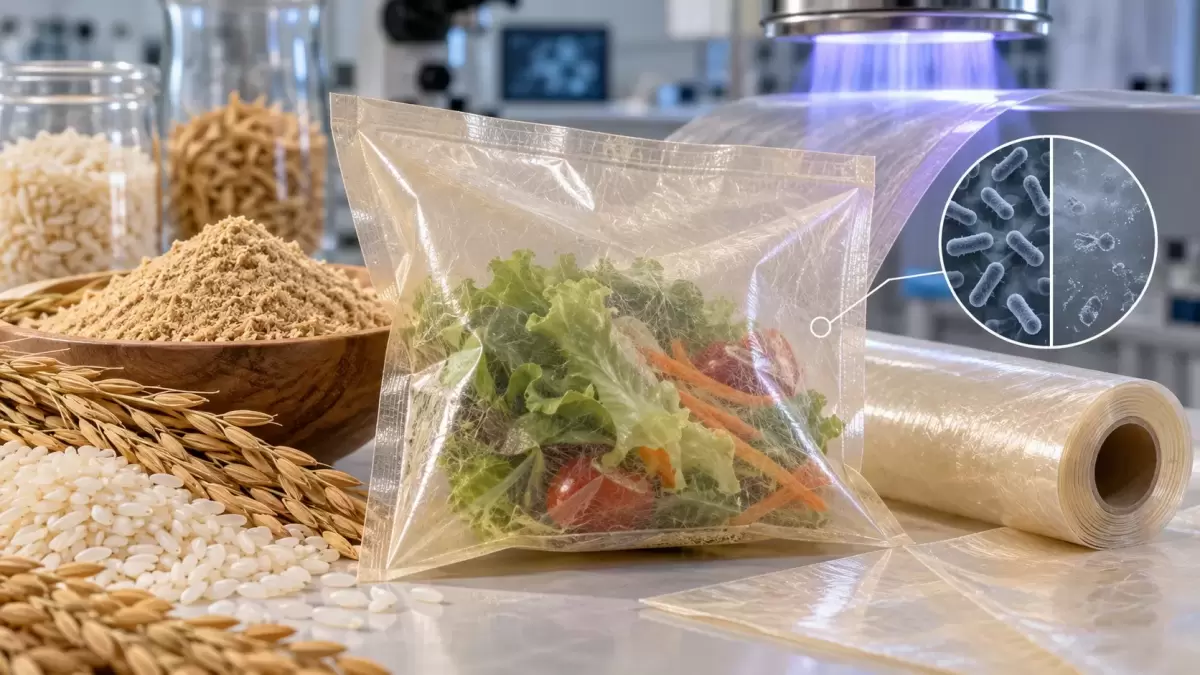
Researchers at the Arkansas Agricultural Experiment Station have developed a biodegradable food packaging film made from rice bran protein that gains antimicrobial properties after treatment with cold argon plasma.
The research turns an underused agricultural by-product into a functional packaging material while avoiding the need to add conventional antimicrobial agents such as nanoparticles or antibiotics.
The approach could provide a new route towards biodegradable food packaging capable of actively limiting bacterial growth rather than simply acting as a passive barrier.
Cold plasma activates the rice bran film
The researchers produced transparent films from rice bran and rice bran protein before treating their surfaces with cold plasma generated using argon gas.
The plasma treatment changes the surface chemistry and physical structure of the films, creating microscopic surface features and triggering chemical reactions that generate antimicrobial activity.
The technique was inspired by plasma processes already used in other industries, including semiconductor manufacturing, where plasma is employed to modify and etch material surfaces.
Film inhibits several foodborne bacteria
Tests showed that the plasma-treated rice bran protein film inhibited the growth of several foodborne bacteria, including Escherichia coli, Staphylococcus aureus and Pseudomonas aeruginosa.
Bacterial populations declined within eight hours of exposure to the treated films and remained inhibited after 24 hours.
By comparison, untreated rice bran films showed significant bacterial growth under the same test conditions.
Antimicrobial activity comes from the surface itself
The researchers did not add conventional antimicrobial compounds to the film.
Instead, plasma treatment increased surface roughness and altered the film's chemistry, while also generating and retaining reactive species including hydrogen peroxide.
The combined effect creates an environment that inhibits bacterial growth directly at the surface of the packaging material.
Rice bran becomes more valuable as a packaging feedstock
Rice bran is generated in large quantities during rice milling but is often used in relatively low-value applications.
Turning the material into a biodegradable packaging film could create a higher-value pathway for this agricultural residue while reducing dependence on fossil-derived polymers.
The protein fraction appears particularly promising because it responded more strongly to plasma treatment than films produced from whole rice bran.
Surface roughness increases after treatment
Microscopic analysis showed that plasma treatment increased the surface roughness of rice bran protein films by approximately 3.3 times.
The treatment also increased the concentration of reactive species on the surface, helping explain the observed antimicrobial behaviour.
These changes demonstrate how surface engineering can provide additional functionality without changing the fundamental composition of the biodegradable film.
Plasma treatment could avoid conventional antimicrobial additives
Many antimicrobial packaging systems rely on substances such as nanoparticles or antibiotics to inhibit bacterial growth.
However, the migration of active substances from packaging into food can create additional safety and regulatory questions.
The Arkansas research explores a different approach in which antimicrobial functionality is generated through physical and chemical modification of the packaging surface itself.
Packaging performance still requires further validation
The research remains at an early development stage and several questions need to be answered before the material could be considered for commercial food packaging.
Future studies will need to evaluate moisture and oxygen barrier performance, tensile strength, thermal stability, food-contact safety, migration, shelf-life extension and behaviour under realistic storage conditions.
The durability of the antimicrobial effect will also be important, particularly during manufacturing, handling and prolonged contact with food.
Plasma opens a new route for agricultural waste packaging
The research demonstrates how an agricultural residue can be combined with advanced surface treatment to create a packaging material with functions that are difficult to achieve using conventional biodegradable films.
The next challenge will be determining whether the plasma process can be scaled economically while maintaining consistent antimicrobial performance across large quantities of film.
If successful, the approach could contribute to a new generation of bio-based packaging materials in which waste-derived polymers provide the substrate and advanced surface engineering adds specific functional properties.






Comments (0)