
Seda wins the 2026 European Carton Excellence Award with its patented Da Vinci Clamshell, a rounded paper-based foodservice pack.
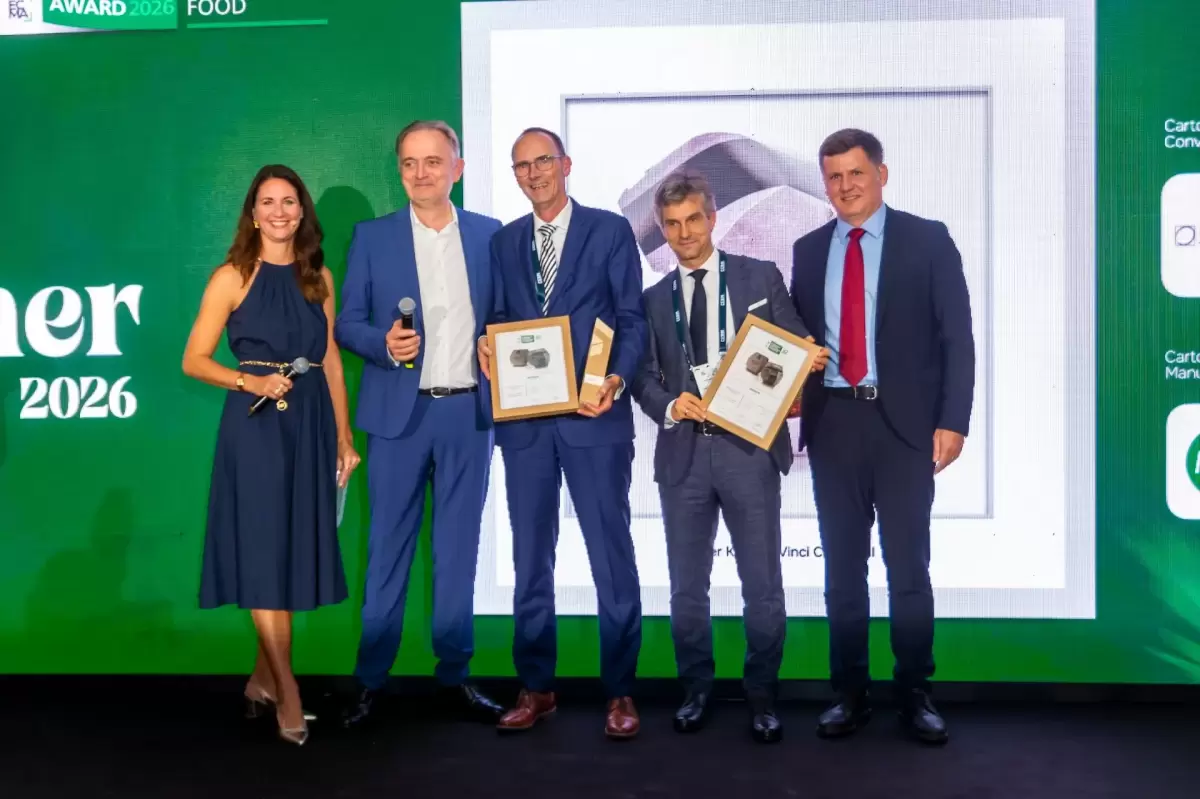
Seda wins European award for a new paper-based foodservice clamshell
Seda International Packaging Group has won the Food category at the European Carton Excellence Awards 2026 with its patented Da Vinci Clamshell, a paper-based foodservice packaging solution designed around both product protection and consumer interaction.
The award was presented during the European Carton Excellence Awards ceremony in Rome on 17 September, recognising packaging innovations across Europe for criteria including design, innovation, convenience, production and cost efficiency.
The Da Vinci Clamshell was developed as an alternative approach to the conventional foodservice clamshell, using a distinctive rounded structure rather than simply adapting a traditional rectangular carton.
Rounded structure follows the shape of the food
One of the defining features of the Da Vinci Clamshell is its rounded upper section, which follows the natural contours of the food product inside.
The geometry helps reduce lateral movement within the pack while creating a distinctive silhouette that can make the product more recognisable.
Rather than treating packaging shape as purely decorative, Seda has used the structure to combine product stability, visual differentiation and consumer experience.
Angled base improves handling
The lower section of the clamshell incorporates an inclined base designed to make the packaged food easier to grip and remove.
This detail addresses a practical problem in foodservice packaging, where consumers may need to handle products while eating on the move or without access to conventional tableware.
The design therefore considers the complete interaction between consumer and package rather than focusing solely on containment and transport.
Paper replaces conventional plastic clamshell structures
The Da Vinci Clamshell is produced using cartonboard and provides a paper-based alternative for foodservice applications traditionally served by plastic containers.
The structure has been developed to maintain the rigidity and protection required for foodservice while offering a fibre-based packaging architecture.
Seda International Packaging Group converts the solution using cartonboard supplied by MM Board & Paper.
Designed for high-volume foodservice operations
Despite its unconventional shape, the pack has been designed around the operational requirements of foodservice environments.
Its geometry supports efficient stacking and handling, allowing the format to be incorporated into high-volume preparation and distribution systems.
This is important because alternative packaging formats can only achieve significant market impact if they remain compatible with the speed and logistics requirements of commercial foodservice.
Packaging becomes part of the consumer experience
The award-winning design reflects a broader shift in foodservice packaging, where the container is increasingly expected to contribute to the consumer experience rather than simply protect the product.
Shape, opening behaviour, handling and visual identity can all influence how consumers perceive and interact with a food product.
For brands, this also creates additional opportunities to use packaging as a communication surface and as part of the product's visual identity.
Structural innovation supports paper packaging adoption
The development demonstrates that replacing plastic with fibre does not necessarily require packaging designers to reproduce existing plastic formats in paper.
Instead, the properties of cartonboard can be incorporated into new structures that reconsider how the package supports the product and how consumers use it.
This approach can create opportunities for fibre-based packaging to compete through functionality and design rather than sustainability claims alone.
Da Vinci Clamshell highlights broader shift in foodservice packaging
The European Carton Excellence Award recognises a development that combines material substitution with structural innovation and consumer-focused design.
As foodservice brands continue to look for alternatives to conventional plastic packaging, the ability to combine fibre-based materials with efficient manufacturing, stackability and practical usability will become increasingly important.
The Da Vinci Clamshell demonstrates how the next generation of paper packaging may be defined not simply by the material used, but by how intelligently the entire package is designed around the product and its use.








Comments (0)