
Sitma launches FlatPack, an automated paper-based packaging system designed to replace plastic wrapping for furniture panels in industrial production.
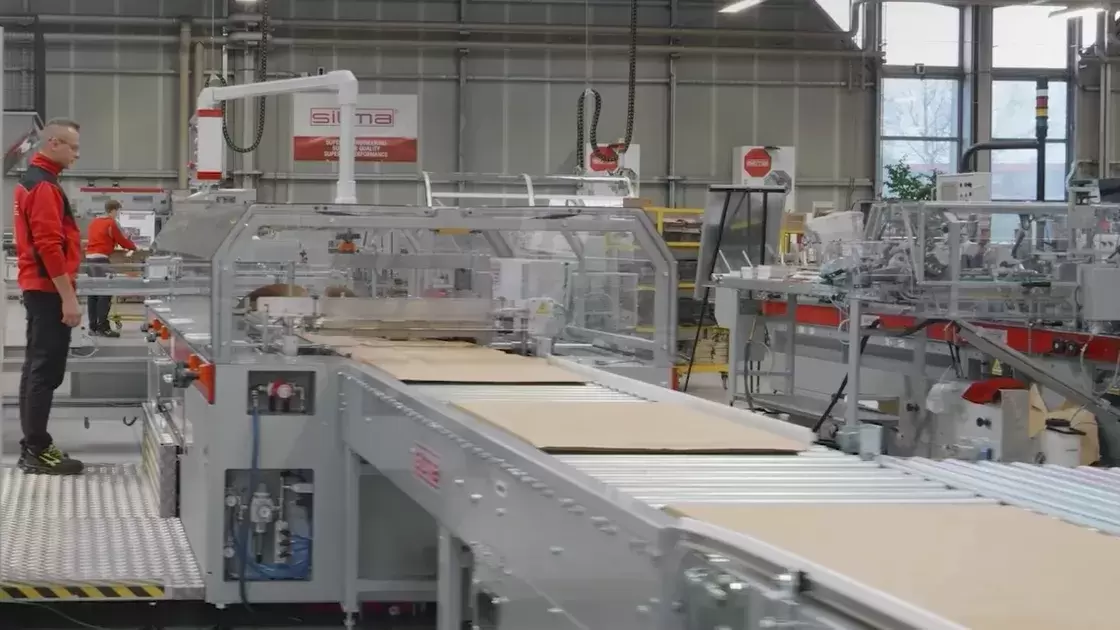
Sitma introduces paper-based packaging for furniture panels
Sitma has launched FlatPack, an automated paper-based wrapping system designed for furniture panels and developed as an alternative to conventional plastic primary packaging in industrial production environments.
The solution was created in collaboration with a leading global furniture manufacturer and aims to help producers reduce their dependence on plastic without compromising packaging protection, production continuity or logistics efficiency. FlatPack combines paper-based materials with automated wrapping technology specifically adapted to the requirements of large-scale furniture manufacturing and distribution.
Fit-to-size wrapping reduces material consumption
FlatPack uses continuous-motion, fit-to-size packaging technology to create compact packs around furniture panels of different dimensions. By adapting the packaging more closely to the size of each product, the system is designed to reduce unnecessary material consumption while maintaining secure protection.
The wrapping geometry folds the material inward rather than creating additional external dimensions. According to Sitma, this approach can improve palletisation, space utilisation and stability during handling and transport, helping manufacturers increase logistics efficiency across warehouses and distribution networks.
Multiple packaging operations integrated into one system
Beyond the primary wrapping process, FlatPack can automate several additional operations within the same production workflow. The system is capable of inserting instruction manuals and printed materials, as well as incorporating hardware boxes, assembly components and toolkits directly into the final package.
Integrating these operations can simplify packaging lines by bringing components that would traditionally require separate handling steps into a single automated process. The system is also designed for compatibility with upstream and downstream automation, enabling manufacturers to incorporate it into broader industrial production environments.
Printable paper adds a communication function
Replacing transparent plastic film with printable paper also changes the role of the packaging surface. Manufacturers can use the outer pack to display product information, assembly instructions, recycling guidance, sustainability messages and brand graphics.
This could reduce the need for additional labels or printed inserts while transforming transport packaging into a communication platform. The ability to print directly onto the paper may also support product identification and improve the presentation of packaged furniture during storage, retail handling and delivery.
Designed for industrial-scale production
A central objective of FlatPack is to demonstrate that replacing plastic with paper does not necessarily require manufacturers to sacrifice productivity. Sitma says the system has been engineered to maintain consistent packaging performance across demanding production and logistics environments.
The technology can adapt to different panel sizes and production requirements, making it suitable not only for furniture but potentially for other industries handling flat or bulky products. Its automated architecture is intended to support scalable deployment where throughput and packaging reliability remain critical.
Paper packaging expands into new industrial applications
FlatPack reflects the broader expansion of fibre-based materials into packaging applications traditionally dominated by flexible plastics. For furniture manufacturers, the challenge is particularly demanding because packaging must combine abrasion resistance, product protection, efficient handling and compatibility with high-volume production.
By combining paper, automation, right-sized packaging and logistics optimisation, Sitma is positioning FlatPack as a practical route towards reducing plastic use while maintaining industrial performance. The solution illustrates how sustainable packaging strategies are increasingly being developed around complete production systems rather than material substitution alone.








Comments (0)