
Smart labels incorporate technologies such as RFID, NFC, QR codes, sensors, and other digital identification systems. A product can carry a small digital identity while continuing to look much like a conventional package.
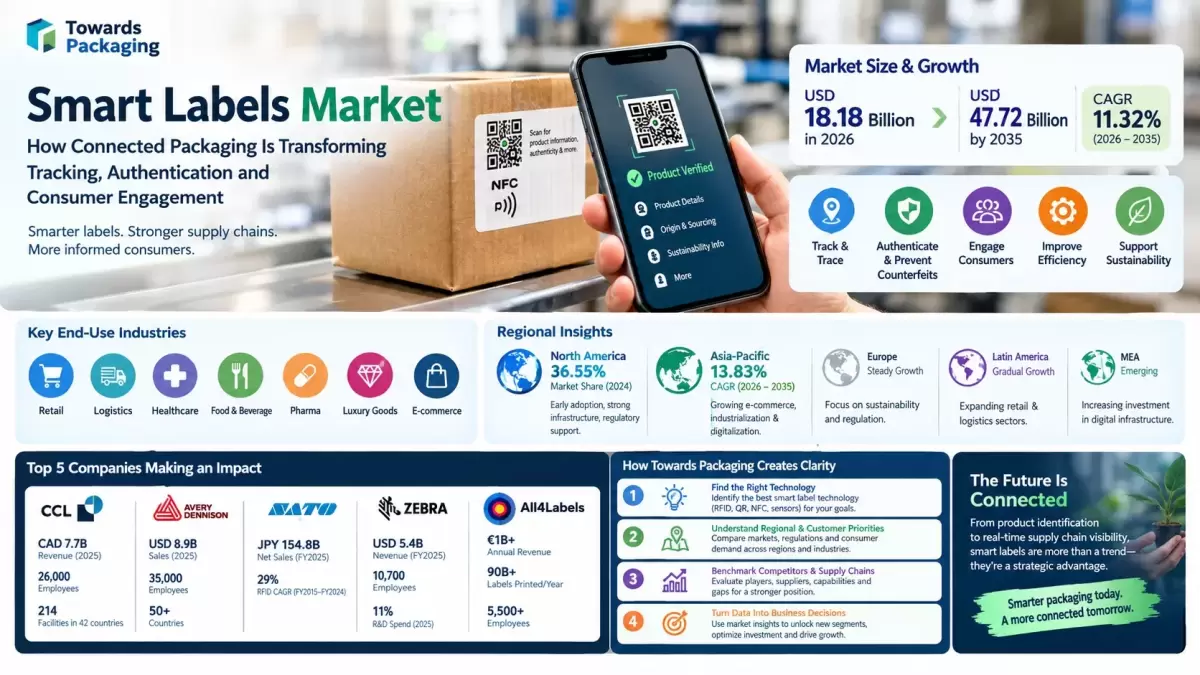
Traditional labels communicate information in a largely one-way format. Smart labels can make that communication interactive.
A QR code, for example, can direct a consumer to product information, promotional content, authenticity verification, instructions, loyalty programs, or digital experiences. RFID can take the concept further by allowing businesses to identify and track products without requiring every individual label to be manually scanned.
The result is a packaging layer that can support both consumer engagement and operational intelligence.
Key applications include:
- Product identification and traceability
- Inventory management
- Anti-counterfeiting and authentication
- Supply-chain monitoring
- Consumer engagement
- Product information access
- Temperature and condition monitoring
- Warehouse automation
- Retail inventory visibility
- Digital product experiences
The combination of these capabilities is particularly valuable as companies attempt to connect physical products with increasingly digital supply chains.
Market Growth Is Being Supported by Retail, Logistics and E-CommerceRetail and logistics are among the strongest areas supporting smart-label adoption.
Large retailers handle enormous volumes of products, making accurate inventory information increasingly important. RFID-enabled labels can help businesses identify products more efficiently and improve visibility from distribution centers to stores.
The expansion of e-commerce is strengthening this requirement. Products now move through more complex fulfillment networks, increasing the need for accurate identification, shipment tracking, inventory visibility, and last-mile coordination.
For companies, smart labels can therefore become part of a wider digital infrastructure rather than simply another packaging component.
The same principle applies to pharmaceuticals and healthcare. Product authenticity, expiry tracking, temperature monitoring, and traceability are particularly important when the consequences of incorrect information can be significant.
North America Leads While Asia-Pacific Gains MomentumRegional development is another important part of the smart labels opportunity.
North America accounted for 36.55% of the market in 2024, supported by early adoption of advanced identification technologies, established technology infrastructure, regulatory requirements, and strong demand for product transparency.
The region has also benefited from sophisticated retail, logistics, healthcare, and e-commerce ecosystems where RFID, connected identification, and automated inventory systems can deliver measurable operational benefits.
Asia-Pacific, meanwhile, is emerging as one of the fastest-growing markets. The region is projected to record a 13.83% CAGR, ahead of the overall market growth rate.
Several factors are supporting this momentum:
- Rapid expansion of e-commerce
- Increasing retail modernization
- Industrial automation
- Growth of manufacturing networks
- Digitalization initiatives
- Rising adoption of smart packaging
- Expansion of pharmaceutical and healthcare industries
- Increasing consumer expectations for product information
China and India are particularly important within this regional growth story as their large consumer markets and expanding manufacturing ecosystems create opportunities for connected packaging technologies.
Consumer Transparency Is Turning Labels Into Digital TouchpointsOne of the most interesting developments in smart labels is the changing relationship between packaging and consumers.
Consumers increasingly want to understand where products come from, what they contain, how they were produced, and whether sustainability claims can be trusted.
Research cited in the supplied market data from the Food Industry Association indicates that consumer demand for transparency increased from 69% in 2018 to 76% in 2023. The same research indicates that 82% of consumers would likely scan a product or QR code to obtain additional information.
That creates a powerful opportunity for brands.
Instead of trying to place every piece of information on a physical label, companies can use the label as an entry point to a broader digital experience.
A consumer might scan a code to discover:
- Product origin and sourcing information
- Ingredients and nutritional details
- Sustainability information
- Authentication details
- Product-use instructions
- Loyalty rewards
- Promotional offers
- Recycling instructions
- Brand stories
- Video demonstrations
This transforms the label from a static information carrier into an interactive communication channel.
Smart Labels Strengthen Anti-Counterfeiting StrategiesCounterfeiting is another major reason companies are investing in smarter identification technologies.
Luxury goods, pharmaceuticals, electronics, cosmetics, and other high-value products are particularly vulnerable to counterfeit activity.






Comments (0)