
New plasma and dry powder coating technologies aim to deliver PFAS-free barriers for recyclable fibre-based food packaging.
New coating technologies target PFAS-free fibre packaging
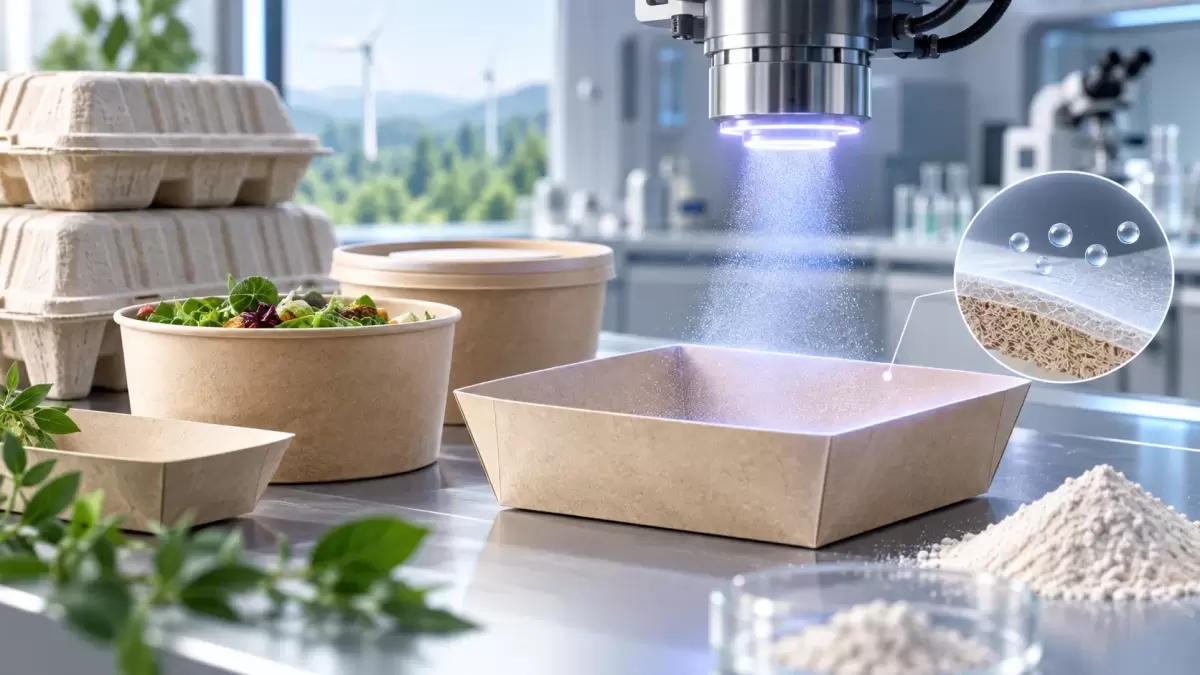
Emerging coating technologies could help fibre-based food packaging achieve the water, grease and gas barrier performance traditionally delivered by plastic laminates and PFAS-based treatments, while maintaining compatibility with recycling systems.
Experts from Spanish technology centre ITENE and the EU-funded Bio-SUSHY project are highlighting new application methods including plasma deposition and electrostatic dry powder coating as promising routes towards high-performance food-contact packaging without persistent fluorinated chemicals.
The developments come as the European Packaging and Packaging Waste Regulation places increasing pressure on manufacturers to reduce substances of concern while ensuring that packaging remains recyclable at scale.
Functional coatings must preserve fibre recyclability
Paper and moulded-fibre packaging are increasingly being positioned as alternatives to plastic formats, but untreated cellulose materials are naturally porous and vulnerable to moisture, oils and gases.
Functional coatings therefore play a critical role in providing the barrier performance required for food applications. However, adding too much coating material or using incompatible polymers can compromise repulpability and fibre recovery during recycling.
ITENE packaging specialist Jesús Palenzuela argues that coating performance should consequently be assessed at the level of the complete packaging structure rather than evaluating the coating material in isolation.
Standardised testing approaches such as those developed by CEPI and Aticelca can help determine whether coated paper packaging can still be effectively repulped and whether valuable cellulose fibres can be recovered.
Plasma deposition enables ultra-thin barriers
One technology attracting attention is plasma deposition, which can apply extremely thin functional layers to packaging substrates without relying on conventional solvent-based coating processes.
Because the deposited layers can be very thin, the technique has the potential to reduce the total amount of barrier material required while maintaining the underlying fibre content of the package.
This could be particularly valuable for packaging manufacturers attempting to improve resistance to moisture, grease or gases without creating complex multi-material structures that are difficult to recycle.
Bio-SUSHY develops alternatives to PFAS
The Bio-SUSHY research project is meanwhile developing bio-based and hybrid coating systems intended to replace PFAS in applications including food trays and textiles.
The project follows the European Commission's Safe and Sustainable by Design framework, assessing materials throughout their lifecycle rather than focusing exclusively on technical performance.
This includes screening raw materials and impurities from sourcing and production through to use and end-of-life, helping researchers identify potential environmental or safety risks before new coating formulations reach commercial scale.
Modelling predicts performance on rough fibre surfaces
Researchers are also using computational modelling to better understand how coatings behave when applied to uneven and porous fibre substrates.
Work conducted with CNR Bologna is helping formulators predict barrier performance on these surfaces, potentially reducing the number of physical trials required during development and allowing coating formulations to be optimised more efficiently.
This approach is particularly important for moulded-fibre packaging, where variations in surface structure can significantly affect coating uniformity and barrier effectiveness.
Dry powder coating removes solvents from application
Another technology under investigation is electrostatic dry powder coating. Instead of applying a liquid formulation, dry coating particles are deposited electrostatically onto the packaging substrate.
In applications such as takeaway food containers, the coating can then be cured during the thermoforming process, combining forming and barrier development within the same manufacturing sequence.
The absence of a liquid carrier offers the potential to eliminate solvents and reduce drying requirements, while also simplifying coating application and lowering energy consumption.
Coatings become central to recyclable food packaging
The transition away from PFAS is increasing demand for coating systems that can deliver several requirements simultaneously: food-contact safety, grease and moisture resistance, minimal material use and compatibility with existing fibre recycling infrastructure.
Technologies such as plasma deposition and dry powder coating demonstrate that progress may depend not only on developing new barrier chemistries, but also on changing how those materials are applied to packaging.
As fibre-based formats move into increasingly demanding food applications, advanced coating processes are likely to become a key enabling technology for replacing plastic laminates and PFAS treatments without sacrificing product protection or recyclability.







Comments (0)