
Coveris develops a nylon-free, recycle-ready thermoforming pack for flatbread, combining high barrier performance with a validated 12-week shelf life.
Coveris brings recycle-ready thermoforming to flatbread packaging
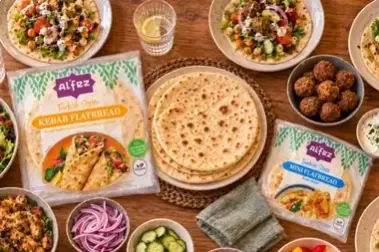
Coveris has launched PolyFlex Thermoform, a recycle-ready high-barrier thermoforming packaging solution developed with Signature Flatbreads and Al’Fez for a range of flatbread products.
The new packaging has been introduced across three Al’Fez flatbread varieties and is available through retailers in the UK and European Union.
The development targets a challenging area of food packaging, where high barrier performance and product protection have traditionally required complex structures that can be difficult to recycle.
Nylon-free structure targets improved recyclability
PolyFlex Thermoform uses a nylon-free polyolefin structure combining polyethylene and polypropylene in the lidding film with a monomaterial polyethylene base web.
The structure has been designed as a recycle-ready alternative to conventional thermoformed food packaging formats that rely on more complex material combinations.
The approach aims to improve compatibility with existing soft plastic recycling systems while maintaining the functional properties required for food packaging.
High barrier performance protects flatbreads
Flatbread packaging needs to protect the product from external conditions while maintaining quality throughout distribution and retail storage.
Coveris developed the structure to provide effective barrier properties while maintaining strong heat and puncture resistance.
The packaging also provides high optical clarity, allowing consumers to see the product while maintaining the protective characteristics required for the application.
12-week shelf life validated
The new structure has undergone shelf-life validation and achieved a validated 12-week shelf life for the packaged flatbread products.
This is an important requirement when replacing incumbent packaging because a recyclable structure must still provide sufficient protection to maintain product quality throughout the intended distribution and retail period.
Designed for existing packing lines
Another focus of the development was compatibility with existing packaging equipment.
PolyFlex Thermoform has been engineered to run consistently on existing packing lines, helping manufacturers adopt the new structure without requiring a complete change to their production infrastructure.
This can reduce the operational barriers associated with introducing alternative packaging materials at commercial scale.
Packaging redesign targets the full application
The Coveris, Signature Flatbreads and Al’Fez collaboration demonstrates how recyclable packaging development increasingly focuses on the complete application rather than material substitution alone.
The packaging must combine barrier performance, shelf life, mechanical resistance, optical properties and processing compatibility while also improving its end-of-life profile.
This balance is particularly important in food packaging, where changes to material structures cannot compromise product protection.
Soft plastic recycling supports the new format
The packaging is currently recyclable through front-of-store soft plastic collection points at major UK retailers.
It has also been developed in line with the UK's Simpler Recycling initiative, which is scheduled to introduce mandatory kerbside collection of soft plastic films and bags from 2030.
The development therefore connects packaging redesign with the evolution of the recycling infrastructure available for flexible plastic packaging.
Thermoforming moves towards circular material structures
Thermoformed food packaging has traditionally relied on multilayer structures to achieve the barrier and mechanical properties required by sensitive products.
New polyolefin-based structures are allowing packaging manufacturers to simplify these constructions while retaining the functionality required by food producers.
PolyFlex Thermoform demonstrates how this approach can be applied to bakery products while maintaining commercial production and shelf-life requirements.
Recyclability and performance need to advance together
The launch highlights a wider transition in food packaging: recyclable structures must deliver the same practical performance expected from established formats.
For brands and converters, the most relevant solutions are therefore those that combine improved end-of-life potential with validated shelf life, reliable processing and effective product protection.
The Coveris development shows how high-barrier thermoforming can move towards more circular material structures without abandoning the performance requirements of modern food packaging.







Comments (0)